Rep. Tom Suozzi: Democrats Must Reject the DSA

September 1, 2026
Publication: The Free Press
By: Tom Suozzi
The Democratic congressman warns that the socialist organization is a dire threat to his party and the country.
Rep. Tom Suozzi represents New York’s 3rd Congressional District, which stretches from northeastern Queens in New York City to a vast swath of suburban Long Island. He’s been an uncompromising critic of his party’s far-left flank, authoring the “Promise to America” earlier this year, with a number of other Democrats, to rebuke socialism and reaffirm what he believes are his party’s core principles. Today, he offers a stark warning to his fellow Democrats on what happens “when a determined ideological movement catches a party divided, complacent, or unprepared.” We hope you read the whole thing. —Will Rahn
Millions of Americans are losing faith in their government, their institutions, and an economic system that no longer seems to reward hard work. They struggle to afford housing, healthcare, and education while watching wealth become increasingly concentrated at the top. They’re mad as hell, in other words, and they’re not going to take it anymore.
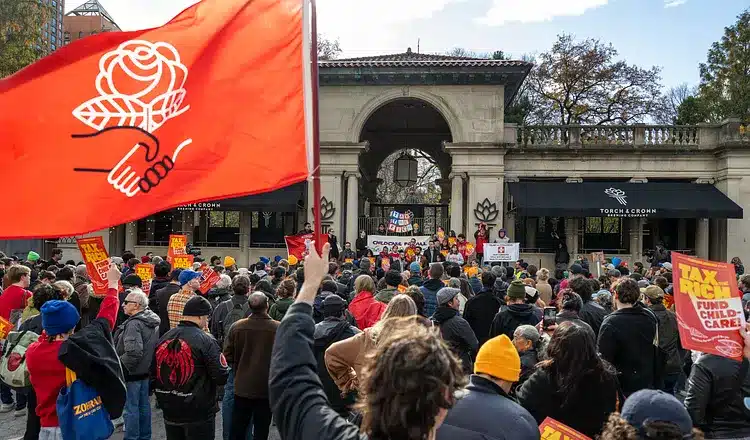
But if Democrats are going to earn the confidence of these Americans this November and beyond, the answer will not be found in the Democratic Socialists of America’s (DSA) platform. Although relatively small in number—the organization counts 120,000 members in a country of some 330 million people—the DSA is aggressive and disciplined. Candidates affiliated with the group are winning Democratic primaries. But we cannot allow them to drag our party to the far left.
Modern political history offers two stark warnings about what can happen when a determined ideological movement catches a party divided, complacent, or unprepared. We’ll start with the Republicans.
In 1964, GOP leaders badly underestimated Barry Goldwater, a fiercely right-wing Arizona senator. Many considered his views too conservative and his appeal too narrow. But Goldwater’s supporters were better organized and understood that party contests can be won by mobilizing passionate voters while the broader electorate remains divided or disengaged.
Goldwater won the Republican presidential nomination but then suffered one of the largest defeats in history that November. Lyndon Johnson carried 44 states and more than 60 percent of the popular vote.
Eight years later, Democrats experienced their own ideological takeover.
South Dakota senator George McGovern was a decent man, a decorated veteran, and a principled opponent of the Vietnam War. His campaign inspired activists who believed the party needed fundamental change.
But his supporters were more representative of the activist class than of the general electorate. His campaign mastered new primary rules while traditional Democrats divided their support and failed to recognize his strength until it was too late.
McGovern won the nomination in 1972 and President Richard Nixon defeated him easily, taking 49 states and more than 60 percent of the vote. At the same time, however, more moderate Democrats defeated Republicans in a slew of down ballot races, retaining control of the House and even expanding their majority in the Senate.
The lesson is not that parties should silence ideological movements. It is that intensity is not the same as broad public support, and success in a primary is not the same as electability in November. That distinction could determine control of Congress in this year’s elections.
The consequences of McGovern’s defeat lasted far beyond 1972. Jimmy Carter narrowly won the 1976 election in the wake of Watergate, but Democrats then lost three consecutive presidential elections—two by landslides. It was not until Bill Clinton’s victory in 1992, when he ran as a pragmatic Southern moderate 20 years after McGovern, that Democrats truly regained their footing as a competitive national party.
Today, both the DSA and Donald Trump’s MAGA movement have recognized genuine public anger, and now they’re exploiting it. But socialism on the left and authoritarianism on the right are dangerous answers to legitimate problems.
Capitalism and democracy helped make America prosperous, innovative, and powerful, but neither is self-correcting. Unchecked capitalism can concentrate wealth and crush market competition. A hostile and paralyzed government can destroy confidence in democracy. We must repair both systems, not abandon one or surrender the other.
Intensity is not the same as broad public support, and success in a primary is not the same as electability in November.
The DSA is not proposing that we become more like Denmark or Norway, two liberal democracies with universal healthcare and a more robust social safety net. Instead, they propose something much more radical.
Just look at the platform the DSA released on July 14. It calls for abolishing immigration enforcement, police departments, and prisons; getting rid of the Senate and having the president and Supreme Court appointed by a unicameral legislature; and giving the government ownership of all “food, education, energy, medicine, and transportation” industries.
These are not proposals to make capitalism fairer or the government more responsive. They would eliminate constitutional checks and balances, give unprecedented power to the federal government, and depend on the assumption that the people who lead our government will always use that power responsibly.
Remarkably, the DSA seems to have learned nothing from the Trump era. As the Founders recognized, politicians are not angels. The government simply cannot be trusted with limitless power, regardless of whether the president is Donald Trump or a DSA alternative.
Americans need relief from the costs of housing, healthcare, education, and raising a family. But solving those problems does not require them to surrender the dream of starting a business or owning a home. Yet the DSA agenda does not once mention the words small business or entrepreneur. It invites you to imagine a world where “you don’t pay a mortgage,” which is a world where you can’t or don’t own your own home.
What they want, in other words, is not European-style social democracy but something closer to Cuba’s faltering dictatorship. If you don’t believe me, read the laudatory statement they recently released on the 100th anniversary of Fidel Castro’s birth.
The country they want to create is not one that most Americans would want to live in. Theirs is a vision that will never resonate in the congressional district I represent, or in most other cities, towns, and states across America.
Just look at the polls: Gallup recently found that only 39 percent of Americans view socialism favorably, compared with 54 percent for capitalism and 81 percent for free enterprise. When asked by Gallup what they like about socialism, the most popular answer was “nothing.” And a new Siena survey found that New York voters view the DSA unfavorably by 47 to 30 percent—including 57 percent of independents. In one of America’s most Democratic states, that is an unmistakable warning.
Democrats have a genuine opportunity to win back the House and the Senate this year. But the election will be decided largely in competitive districts and states where candidates must appeal not only to the Democratic base but also to independents, moderates, suburban voters, and working-class families who may not identify with either party. Candidates aligned with the DSA can win in places where Republicans don’t even bother to compete, like New York City’s “Commie Corridor.”